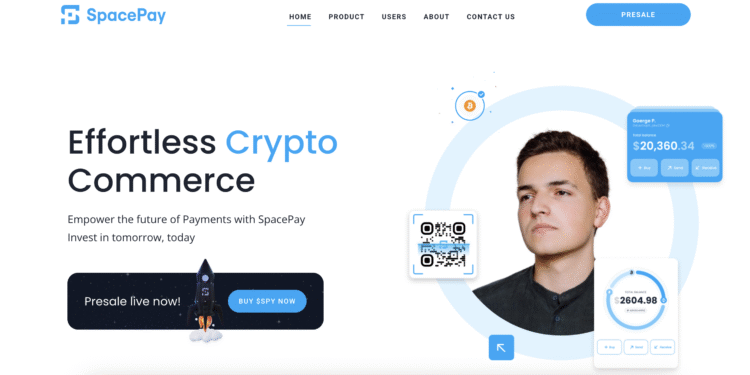


7 Alarming Warning Signals About SpacePay.co.uk — Presale Project With Major Risk Indicators
SpacePay.co.uk claims to be a fintech/presale crypto payments project that lets merchants accept cryptocurrency through Android POS (Point of Sale) terminals, promoting a token called $SPY, and promising seamless fiat conversion. On its face, it looks like a modern payments solution with ambitious reach. But under the surface, there are multiple concerning signals that align strongly with crypto scam risk, unverified operations, and serious hurdles for crypto recovery should things go wrong.
First, the original company SpacePay Ltd was dissolved in mid-2023. A new company, SpacePay Limited (or SpacePay Group Ltd) was registered recently. The reason for the dissolution, transition, and whether debts or liabilities were transferred is not clearly explained. Such restructuring, especially in presale projects, is often used to avoid accountability, confuse customers, or escape past commitments. This raises red flags about continuity and trust.
Second, there is no evidence that SpacePay.co.uk is regulated by any major financial regulator. It does not appear on FCA registries or similar bodies, and reviews explicitly state it is unlicensed and unregulated. Without regulation, investors have no formal protection; if funds are misused, there is no overseer, no guarantee of accountability, and limited recourse for crypto recovery efforts.
Third, the marketing promises appear overly ambitious and possibly unrealistic. The project claims the ability to tap into “over 400 million new customers,” promise ease of integrating crypto into POS in a low-risk way, and imply smooth transactions for merchants, possibly without clearly disclosed fees or risk. Such language is frequently seen in trading fraud or presale hype designed to draw in investors before the real costs or technical challenges become apparent.
Fourth, transparency appears limited. Many sources note lack of verifiable details about team members, use of stock images, sparse audit proofs or technical demonstration for how the POS integration actually works. The white paper (if it exists) seems not widely circulated or lacking substantiation in third-party sources. Without clear disclosures, trust is fragile.
Fifth, community sentiment includes warning voices. On Reddit and various scam tracking sites, users report suspicious behavior: presale token promises, difficulty verifying legitimacy, complaints about withdrawals or token distribution, concerns about unrealistic ROI, and fears of this being a presale scam or promotional front. Such voices often surface before larger problems emerge, so they are strong early warning signs.
Sixth, domain / operational data shows mixed legitimacy. The domain is older than some newer scam sites, has valid SSL, and has certain hosting or registrar credentials that are not immediately disqualifying. However, older domain age or SSL alone are not proof of safety. Combining those with vague business claims, lack of regulation, and presale model makes risk higher.
TO FIND LOST FUNDS, CLICK HERE
Seventh, for any investor who participates in the presale or deposits funds, crypto recovery is likely to be extremely difficult. Presale tokens often have lock-up periods, lack of liquidity, possible delays in token delivery or listing, or may never list. If funds are lost or tokens are not distributed or the project fails, getting money back is rarely straightforward. Evidence like transaction receipts, communication records, and wallet addresses is essential, but even then, recovery specialists often find that once a presale operation has minimal transparency and no regulatory oversight, full recovery is rare.
Conclusion
SpacePay.co.uk represents a classic case of a high-risk presale crypto project that shows some shiny features but many warning signals. Its promise to revolutionize POS payments with crypto, and to allow merchants to accept cryptocurrency via Android POS terminals, is a bold ambition. However, ambitions must be backed with regulation, proof, and trust. The fact that the original company was dissolved, replaced by a new one, with little explanation, undermines confidence. Regulation serves as a guardrail: it ensures compliance with financial laws, consumer protection, honest disclosures, and operational transparency. SpacePay currently lacks that guardrail, which places investor funds at risk from mismanagement, misleading claims, or worse.
Misleading promises of large customer reach and effortless integration should be approached with suspicion. Markets are complicated, technical integrations are costly and risky, and presales commonly fail to deliver promised outcomes. The mismatch between what is promised and what is proven is a hallmark of many crypto scam projects. It is especially risky if people are pushed toward investing based on marketing hype, FOMO (fear of missing out), or token presale prospects without sufficient technical and regulatory validation.
Transparency is critical in evaluating such projects. When claims about team members, audits, partnerships, or technical proofs are vague or missing, that suggests possible deception or hiding of risk. Without visible proof of a functional product, relevant licensing, or third-party verification, promises remain just words. Investors need verified white papers, known founders, clear roadmaps, and confirmed listings or partnerships to gauge legitimacy.
Community feedback is an early and important indicator. The warnings from Reddit threads and scam review sites reveal that there is concern about SpacePay among people who have dug deeper. While those reports are not definitive proof of wrongdoing, they raise enough suspicion that participating in the presale should be approached very cautiously. Especially when user complaints include failed token delivery, missing information, or unverifiable promises.
Given all these factors, crypto recovery after loss in a case like SpacePay is likely to be difficult, costly, and uncertain. Once funds are committed (especially via presale), if tokens are never delivered or the project halts, reverse actions are limited. Presales often rely on crypto or digital payments, which are irreversible. Even with proof, legal avenues are often slow, expensive, and jurisdictionally complex. Recovery services may help, but full reimbursement is seldom achieved.
In short, SpacePay.co.uk is not conclusively proven to be a fraudulent operation, but it contains many of the same red flags that accompany projects that turn into crypto scam. The lack of regulation, dissolution of earlier entity, ambitious claims with little substantiation, and community concern all combine into a risk profile that is higher than average.
The best advice: if you consider engaging with SpacePay (especially investing or participating in the presale), do so only with money you can afford to lose. Seek audited proof of their technology, regulatory registration, and verifiable team and partnerships. Hold off until token delivery is confirmed or product is working. Keep all transaction proofs. Be very skeptical of perfect promises. Prevention is your strongest tool, because once funds are lost in an unregulated presale, crypto recovery becomes a steep, often unsuccessful climb.